China’s PUF Insulated Control Room market supports demanding applications across power, energy, chemicals, and manufacturing. Buyers need more than attractive panel prices. They need verified thermal performance, fire behavior, airtightness, and installation quality.
MarketsandMarkets estimates the global cleanroom technology market could grow from about USD 7.1 billion in 2024 to USD 11.1 billion by 2029. Grand View Research also reports continued expansion in the global sandwich panel sector, driven by energy efficiency and modular construction. These figures show stronger demand for controlled, prefabricated environments. They do not guarantee equal quality among suppliers.
Dr. John Straube, a recognized building-envelope expert, states, “Insulation is not a substitute for air sealing.” That warning matters inside every PUF Insulated Control Room. A poorly sealed joint can admit humid air, create condensation, and weaken temperature stability. Reliable manufacturers therefore document panel density, core thickness, thermal conductivity, joint design, and testing procedures. They should also explain how doors, cable penetrations, lighting, and HVAC interfaces are sealed.
This China Top 10 ranking considers those practical details. It also examines customization, production experience, certifications, project references, and after-sales support. No ranking is perfectly objective. Supplier data can change, and published claims require independent verification. Some manufacturers excel in rapid delivery, while others provide stronger engineering support. The best choice depends on operating temperature, cleanliness requirements, fire strategy, and local compliance needs. Small details matter.
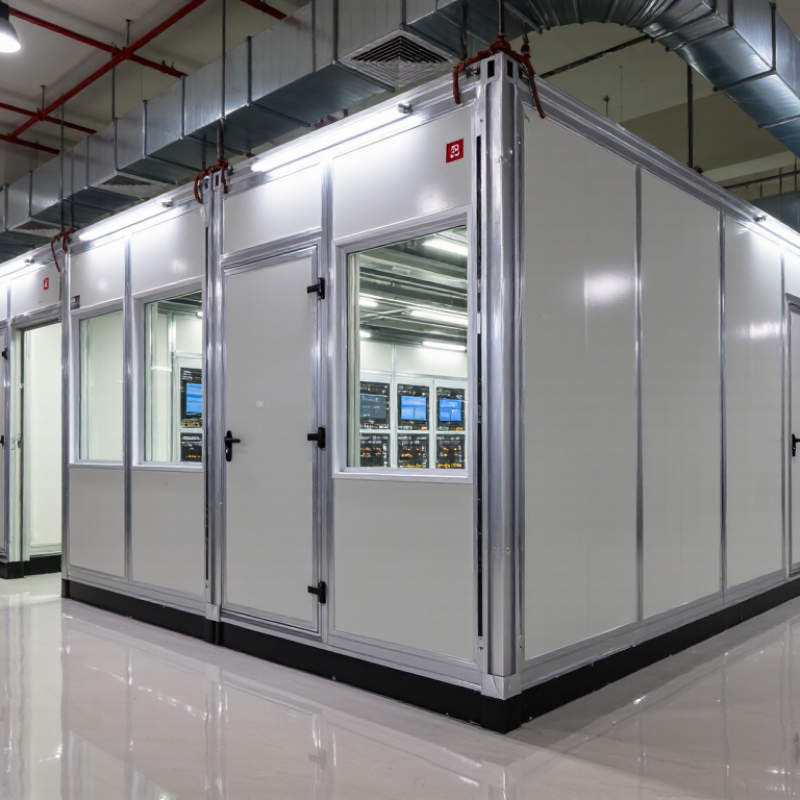
PUF Insulated Control Rooms: Structure, Features, and Applications
PUF insulated control rooms use rigid polyurethane foam between protective steel panels. The sandwich structure reduces heat transfer and creates a stable enclosure for sensitive equipment. Panel joints usually include interlocking profiles, sealants, and compression gaskets. These details limit dust, moisture, and uncontrolled air leakage.
A well-designed room also needs a structural frame, raised floor, cable entries, lighting, ventilation, and access doors. PUF insulation supports energy efficiency, especially when outdoor temperatures change sharply. However, insulation alone does not guarantee safety. Designers must verify fire performance, smoke behavior, grounding, and local building requirements. Thermal bridges around doors and cable penetrations are often underestimated.
These rooms serve power substations, factories, automation lines, laboratories, and remote monitoring stations. In practice, stable temperature helps protect control panels, servers, and communication devices from condensation and overheating. Noise reduction can improve operator comfort too. Manufacturing quality matters. Panels should be checked for thickness, density, surface flatness, and joint alignment before installation. A room may look finished, yet poorly sealed corners can weaken its performance. This is easy to miss.
Reliable manufacturers usually provide drawings, material certificates, factory inspection records, and installation guidance. They should also explain maintenance access and replacement procedures clearly. One limitation deserves attention: PUF may not suit every fire-risk environment without additional protection. A careful specification is better than a quick selection.
How China’s Top 10 Manufacturers Are Selected and Compared
China Top 10 PUF Insulated Control Room Manufacturers
The selection begins with evidence, not factory size. Each manufacturer is reviewed against PUF core density, panel thickness, thermal conductivity, and dimensional tolerance. These values should come from accredited laboratory reports, not only product brochures. EN 14509 and relevant Chinese testing standards provide a practical comparison framework for insulated sandwich panels.
Energy performance matters. The 2024 UNEP Global Status Report for Buildings and Construction states that buildings consumed about 32% of global energy in 2022. A control room with weak insulation can increase cooling demand, especially under China’s hot summers. We therefore compare tested U-values, door sealing, cold-bridge treatment, and performance after repeated temperature changes. Small gaps around cable entries deserve attention. They are often ignored.
Reliability is measured through traceability and field experience. The ranking checks ISO 9001 systems, batch records, fire-test documentation, installation guidance, warranty terms, and completed control-room projects. Manufacturers with repeatable production usually show tighter panel joints and cleaner corners. Capacity alone proves little. Some factory claims still lack independent verification, so scores should be adjusted when evidence is incomplete. A transparent comparison gives higher weight to laboratory results, site feedback, and after-sales response than to polished marketing language.
Profiles of China’s Top 10 PUF Control Room Manufacturers
China’s top 10 PUF control room manufacturers differ in engineering depth, factory discipline, and project experience.
Their profiles should be judged beyond catalog images. Key evidence includes panel density reports, thermal conductivity data, fire testing, and documented installation records. Experienced manufacturers usually explain how their polyurethane foam panels perform in hot, humid, dusty, or coastal environments.
Several companies focus on modular control rooms for power stations, factories, and infrastructure sites. Their strengths may include precise panel cutting, steel-frame integration, cable-entry planning, and fast assembly. Others provide customized enclosures with raised floors, insulated doors, observation windows, and ventilation coordination.
Small details matter. A poorly sealed joint can reduce efficiency and invite condensation.
Reliable suppliers normally share drawings, inspection steps, and material traceability before production.
The strongest profiles also reveal after-sales capability. Site guidance, replacement support, and maintenance documents can prevent costly delays. However, no manufacturer should be rated only by certifications or polished presentations. Some published specifications need independent verification, and project references may not show difficult operating conditions.
A practical review should compare lead times, tolerance control, warranty terms, and communication during design changes.
One weakness remains easy to overlook: a capable factory may still struggle with complex electrical coordination. Careful buyers should request samples, factory records, and clear acceptance criteria before signing.
Key Differences in Products, Certifications, and Manufacturing Capabilities
China Top 10 PUF Insulated Control Room Manufacturers
Comparing China’s top ten PUF insulated control room manufacturers requires more than checking panel prices. Product quality often differs in core density, thickness, joint design, and surface coating. A 100 mm panel may look identical in photographs, yet its thermal performance can vary. Ask for tested U-values, fire behavior, and dimensional tolerances. Inspect the cam-lock joints closely. Poor alignment creates air leakage and weakens temperature control.
Certifications reveal another clear difference. Reliable manufacturers usually maintain ISO 9001 quality systems and provide material traceability. Export projects may also require CE documentation, EN fire classifications, or ASTM-based test reports. These documents should identify the tested product, not merely display a general factory certificate. Some suppliers offer cleanroom panels, anti-static flooring, fire-rated doors, and integrated HVAC interfaces. Others only assemble basic enclosures. That gap affects installation risk.
Manufacturing capability matters during site changes. A factory with CNC cutting, automated panel lines, and documented factory acceptance testing can respond more consistently. Check welding quality, corner finishing, cable penetrations, and door hardware before shipment. Request sample records and photograph each inspection point. Experience helps, but it is not proof. A polished certificate can still hide uneven foam filling or delayed replacement parts. I would also question unusually short lead times. They may be accurate. They may not.
China Top 10 PUF Insulated Control Room Manufacturers — Key Differences in Products, Certifications, and Manufacturing Capabilities
The chart presents a non-company-specific engineering benchmark for commonly specified polyurethane foam (PUF) panel thicknesses. The centerline U-values are calculated using a representative PUF thermal conductivity of 0.024 W/m·K and internal/external surface resistances of 0.17 m²·K/W. Lower U-values indicate better thermal insulation.
When comparing manufacturers, review panel thickness options, joint and thermal-bridge design, cleanroom or control-room integration, and documented compliance with applicable standards such as EN 14509 for factory-made sandwich panels, EN 13501-1 for reaction-to-fire classification, and ISO 9001 for quality-management systems. Actual building performance also depends on doors, windows, joints, HVAC systems, and installation quality.
How to Choose a Suitable Chinese PUF Control Room Manufacturer
Choosing a Chinese PUF insulated control room manufacturer requires more than comparing panel prices. Define the room’s actual duty, including equipment heat, occupancy, temperature, humidity, noise, and fire performance. Ask for panel density, steel thickness, thermal conductivity, joint design, and test evidence. A clear specification prevents unsuitable quotations. Keep records.
Visit the factory, physically or through a live video audit. Check foaming equipment, panel curing areas, dimensional inspection, and storage conditions. Request recent references with similar room sizes and climates. Examine door seals, cable penetrations, floor loading, and lifting points. These details often decide whether installation is smooth. A manufacturer should explain tolerances and replacement procedures, not only show polished photos. Verify that drawings, certificates, and inspection records match the offered configuration.
Compare engineering support, not just production capacity. Ask who will review layouts, calculate cooling loads, and guide site assembly. Confirm packing methods, lead times, spare panels, and after-sales response in writing. A reliable supplier should welcome independent inspection before shipment. Be cautious with “zero maintenance” promises. PUF panels still need seal checks and careful handling. I would test a sample joint before approving the full order; small gaps can cause condensation and dust problems. The cheapest quotation may transfer risk to your installation team. Leave room for revision after the first technical review.
FAQS
It uses rigid polyurethane foam between protective steel panels. This sandwich structure slows heat transfer. It creates a stable enclosure.
Interlocking profiles, sealants, and compression gaskets close panel joints. Poorly sealed corners can still leak. Visual inspection is not enough.
They can house control panels, servers, communication devices, and monitoring equipment. Typical sites include factories and laboratories.
A complete room needs a structural frame, raised floor, lighting, ventilation, cable entries, and access doors. Maintenance access matters too.
No. Designers must verify fire performance, smoke behavior, grounding, and local building requirements. Some high-risk areas need additional protection.
Doors and cable penetrations can create thermal bridges. Small gaps may increase condensation or cooling demand. These details are easy to miss.
Compare tested core density, panel thickness, thermal conductivity, U-values, and dimensional tolerance. Laboratory evidence is stronger than attractive brochures.
Useful documents include drawings, material certificates, inspection records, fire-test evidence, installation guidance, and warranty terms. After-sales response also deserves attention.
Inspect thickness, density, surface flatness, joint alignment, and corner sealing. A finished-looking room may still perform poorly.
Not necessarily. Capacity and polished claims prove little. I would check field feedback and independent evidence before choosing.
Conclusion
This article presents a practical overview of China’s PUF Insulated Control Room manufacturing sector. It explains the structure of PUF insulated panels, steel frameworks, doors, windows, electrical systems, ventilation, and other components, while highlighting their advantages in thermal insulation, fire resistance, noise reduction, durability, and rapid installation. It also introduces common applications in industrial plants, energy facilities, laboratories, data centers, and other controlled environments.
The article outlines how China’s top 10 manufacturers are selected and compared according to product quality, engineering experience, customization ability, certifications, production capacity, testing standards, delivery performance, and after-sales support. It then summarizes the different strengths of these manufacturers without focusing on brand names, helping readers understand variations in materials, panel thickness, structural design, manufacturing capabilities, and compliance documentation. Finally, it provides practical guidance for choosing a suitable Chinese PUF Insulated Control Room manufacturer based on project requirements, operating conditions, budget, installation needs, quality expectations, and long-term service.