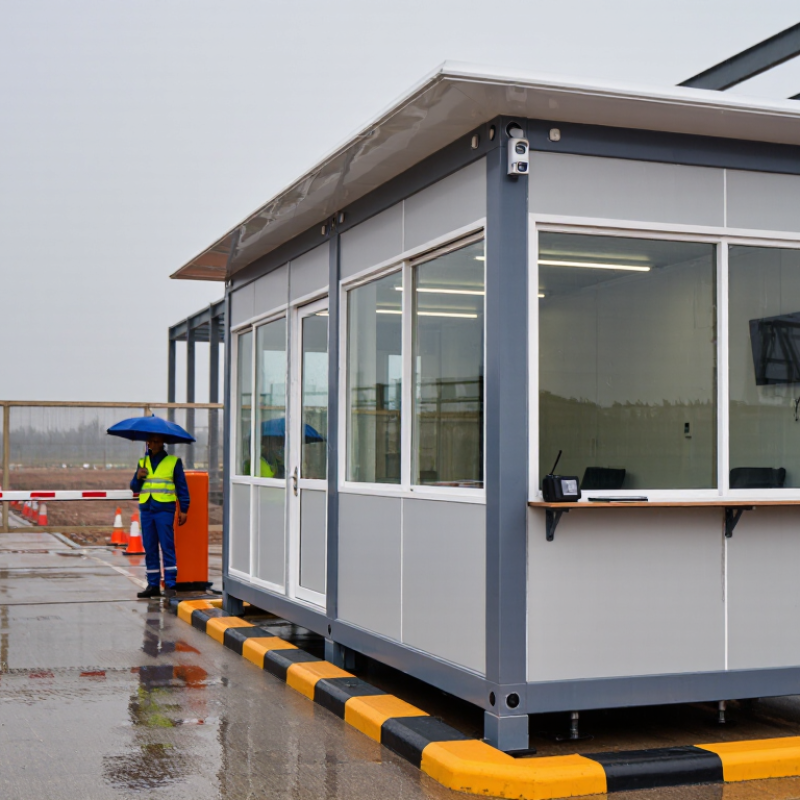
At a construction entrance, a guard may need to check visitors, answer a radio, and watch the vehicle gate while rain gathers on the windscreen. A Prefab Security Cabin provides a nearby, enclosed base for these tasks. It is commonly used at construction sites, warehouses, industrial facilities, utility locations, and event entrances. Depending on its layout, it can support visitor check-in, access monitoring, incident logs, and basic communications. Some units include glazing with clear sightlines, a counter, lighting, insulation, or power for monitoring equipment. Small details matter. A poorly positioned cabin can leave blind spots or make routine conversations difficult.
The need for staffed posts is substantial. The U.S. Bureau of Labor Statistics’ Occupational Outlook Handbook reports roughly 1.2 million security guard jobs in 2023, with employment projected to grow 3 percent from 2023 to 2033. That figure does not measure demand for cabins, but it shows the scale of staffed security work. Prefabrication can also help teams prepare a site sooner. McKinsey’s 2019 analysis, “Modular construction: From projects to products,” describes schedule reductions of 20 to 50 percent for modular construction in suitable projects. Results vary by design, transport, and site preparation. A cabin is not a security plan. It cannot replace trained staff, clear procedures, or a careful assessment of sightlines and access needs. That distinction is easy to overlook.
What a Prefab Security Cabin Is
What a Prefab Security Cabin Is
A prefab security cabin is a compact, factory-built shelter designed for security staff at entrances, parking areas, construction sites, or facility perimeters. Its walls, roof, door, and windows are assembled before delivery, then the unit is positioned on a prepared base. This can reduce on-site building work, though access for delivery equipment still needs planning.
A typical cabin has clear windows for viewing approaching vehicles, a lockable door, lighting, and space for a desk or monitor. Depending on the site, it may also include insulation, heating, cooling, or electrical connections. These features are not automatic; they should be specified to match local weather and daily operating needs.
Small details matter. A poorly placed window can leave a blind spot, while a desk that crowds the doorway makes long shifts less comfortable.
The cabin provides shelter and a defined workstation, but it does not replace good site planning or trained staff. It is not a magic fix. Before choosing a layout, consider sightlines, power access, ground conditions, and how guards enter and leave safely. Even a practical design can miss something; checking the cabin’s position during a site walk-through often reveals issues that a drawing cannot.
How a Security Cabin Controls Site Access
A prefab security cabin turns the site entrance into a staffed checkpoint. A guard can compare a visitor’s name with an approved list, issue a dated pass, and record the vehicle’s plate. At a busy gate, a clear window, desk, radio, and barrier let staff handle arrivals without leaving the entrance unattended. Small details matter.
Access control also supports safer site routines. The U.S. Bureau of Labor Statistics recorded 1,075 fatal work injuries among construction and extraction occupations in its 2023 Census of Fatal Occupational Injuries. A cabin cannot prevent every incident, but it gives staff a place to check inductions, direct drivers, and flag unescorted visitors before they reach active work zones. A simple visitor log can also help supervisors confirm who is on site during a shift.
The setup needs regular attention. Keep the approved-entry list current, explain badge rules, and make sure guards can contact a site manager quickly. Do not collect more personal information than the process needs, and store records securely. That is not foolproof. A guard may miss a detail, especially during a delivery rush; clear procedures and periodic checks matter as much as the cabin itself.
What Is a Prefab Security Cabin Used For? - How a Security Cabin Controls Site Access
| Site or Setting |
Typical Access-Control Tasks |
How the Cabin Supports Control |
Records and Practical Safeguards |
| Construction site |
Check worker credentials, sign in visitors, and direct deliveries to the correct entrance. |
Places the access check beside the site entrance, where a guard can communicate with drivers and coordinate with a gate or barrier. |
Keep visitor and delivery records according to site procedures. Confirm that visitors receive required site instructions and protective equipment before entry. |
| Industrial facility |
Verify approved visitors and contractors, manage entry during staffed hours, and contact an on-site host when needed. |
Provides a staffed checkpoint for checking authorization and coordinating entry with the facility’s access system. |
Collect only information needed for site security, restrict access to records, and follow applicable privacy and retention rules. |
| Warehouse or logistics yard |
Confirm vehicle appointments or delivery details, direct vehicles, and separate authorized traffic from general visitors. |
Gives security staff a clear point to communicate with drivers before they enter loading or storage areas. |
Use clear vehicle routes and sign-in procedures. A cabin does not replace safe traffic management or trained staff. |
| Utility or infrastructure site |
Check that personnel and contractors have permission to access restricted areas. |
Supports a controlled entry point where staff can verify authorization and contact a responsible site representative. |
Follow the site’s security plan and emergency procedures. Entry rules should reflect the specific hazards and authorization requirements. |
| Temporary event site |
Check staff or contractor passes, provide entry directions, and help manage access at a designated gate. |
Creates a visible staffed checkpoint that can coordinate with event stewards and gate equipment. |
Keep emergency routes clear and make sure access procedures align with the event safety plan. |
| Multi-entrance site |
Monitor a secondary entrance or provide a dedicated checkpoint for a particular group or type of vehicle. |
Allows access checks to take place at the point of entry, reducing reliance on an unattended gate. |
Use consistent authorization rules across entrances and define how staff escalate unusual or denied-entry requests. |
Where Prefab Security Cabins Are Commonly Used
Prefab security cabins are commonly placed at construction sites, where entrances may shift as work progresses. Staff can check delivery vehicles, greet visitors, and keep a clear view of the gate. A raised window and exterior lighting help during early starts or rainy shifts. Small details matter. The cabin should sit near the access point without blocking turning space or equipment routes. Construction managers may also choose a layout with room for radios, site plans, and basic record keeping.
At logistics yards and industrial facilities, cabins often stand beside vehicle gates or loading areas. They give staff a sheltered place to monitor arrivals and coordinate access with on-site teams. Parking facilities, campuses, and event venues use them near entrances where visitors need directions or access checks. A cabin’s position matters as much as its size: poor sightlines can leave blind spots, while a long walk to the gate can slow routine tasks. Power, heating, ventilation, and connectivity needs vary by location, so these should be checked before installation. A cabin can support attentive supervision, but it cannot replace clear procedures or regular communication. I would not assume one standard layout works everywhere.
Features That Support Security Operations
A prefab security cabin supports security operations by giving staff a sheltered, visible base near an entrance, loading area, or site perimeter. Its value depends on practical details: broad windows for clear sightlines, glare-controlled lighting, secure doors, and a counter positioned for checking credentials without blocking movement. A radio charger, camera screens, and organized storage keep essential tools close. Small things matter.
The U.S. Bureau of Labor Statistics recorded 740 fatal work injuries involving violence and other injuries by persons or animals in 2023. That figure does not measure cabin effectiveness, but it highlights why safe positioning and reliable communication matter. A well-planned cabin can help staff observe activity and contact support quickly. Heating, cooling, acoustic insulation, and backup power also help maintain attention during long shifts. Comfort is operational, not cosmetic.
Still, a cabin is not a security plan. Poor placement can create blind spots, and reflective glazing may make nighttime visibility harder than expected. Before installation, teams should test views from seated and standing positions, check radio coverage, and map visitor flow. One missed angle matters. Routine inspections should confirm locks, lighting, alarms, and communications work as intended.
How to Select and Position a Security Cabin
A prefab security cabin works best when its location and layout match the work. The U.S. Bureau of Labor Statistics’ Occupational Outlook Handbook reports about 1.2 million security guard jobs in 2023, with employment projected to grow 3% from 2023 to 2033. That scale makes practical post design important. Start by listing each shift’s tasks: checking visitor access, monitoring cameras, recording deliveries, or communicating with site teams.
Choose a cabin with enough room for the actual equipment and movement. Measure the desk, chair, screens, and door swing before ordering. A narrow model may look efficient on a plan but feel cramped during a long shift. Small details matter. Check window positions from seated eye level; glare on a monitor or a blind corner can undermine visibility. Consider insulation, ventilation, lighting, power, and a clear route to the entrance.
Position the cabin where staff can observe key approaches without obstructing vehicle paths, pedestrian routes, or emergency access. Keep sightlines open, and avoid placing windows toward low-angle sunlight where possible. On uneven ground, confirm the base is level and drainage carries rainwater away from the doorway. BLS injury data recorded 2.6 million nonfatal workplace injuries and illnesses in private industry in 2023; that figure is not specific to security posts, but it reinforces the value of safe access and a workable station. Revisit the layout after the first shifts. Real use often reveals what drawings miss.
Conclusion
A Prefab Security Cabin is a ready-made, enclosed space that gives security staff a practical place to monitor entrances and support daily site operations. Positioned near a gate or other access point, it helps staff greet visitors, check their details, communicate with site personnel, and record arrivals and departures. Its presence can make entry procedures clearer while providing a sheltered workspace in changing weather.
These cabins are commonly used at construction sites, industrial facilities, event venues, campuses, and commercial properties. Useful features may include clear windows, suitable lighting, heating or ventilation, power outlets, communication equipment, and a desk arranged for the work required. When selecting a cabin, consider the number of staff, expected visitor flow, available utilities, visibility, and the site’s layout. Positioning it where staff can see approaching traffic and pedestrians—without obstructing movement—can help create an efficient and welcoming access point.