Choosing the best PUF Insulated Clean Room in China requires more than comparing panel prices. It requires evidence, engineering judgment, and verified factory performance. Polyurethane foam panels can provide strong thermal insulation, smooth internal surfaces, and efficient temperature control. These features matter when production areas must remain stable under demanding conditions.
Market reports show why this decision deserves care. MarketsandMarkets valued the global cleanroom technology market at about USD 5 billion in 2023. It forecasts continued growth through 2028, driven by pharmaceuticals, electronics, and medical manufacturing. However, most reports do not isolate PUF panels as a separate category. That limitation matters. Buyers should avoid treating broad market figures as proof of product quality.
Cleanroom specialist William Whyte has emphasized, “The main source of contamination in a cleanroom is the operator.” His observation remains practical. A well-built room can still fail through poor airflow, weak sealing, or careless maintenance. ISO 14644-1 classifies airborne cleanliness by particle concentration, but it does not certify a supplier’s workmanship. The factory must demonstrate particle testing, pressure control, thermal data, and installation records.
The best PUF Insulated Clean Room in China should therefore combine certified materials with disciplined execution. Inspect the panel joints. Check the door seals. Ask for independent test reports. Review the supplier’s experience with similar facilities. A cold, bright room with visible gaps is not a success.
There is no universal winner. The right choice depends on process sensitivity, humidity targets, room classification, budget, and future expansion. Sometimes, the cheapest quotation hides the most expensive correction. Supplier claims should be tested, not simply trusted.
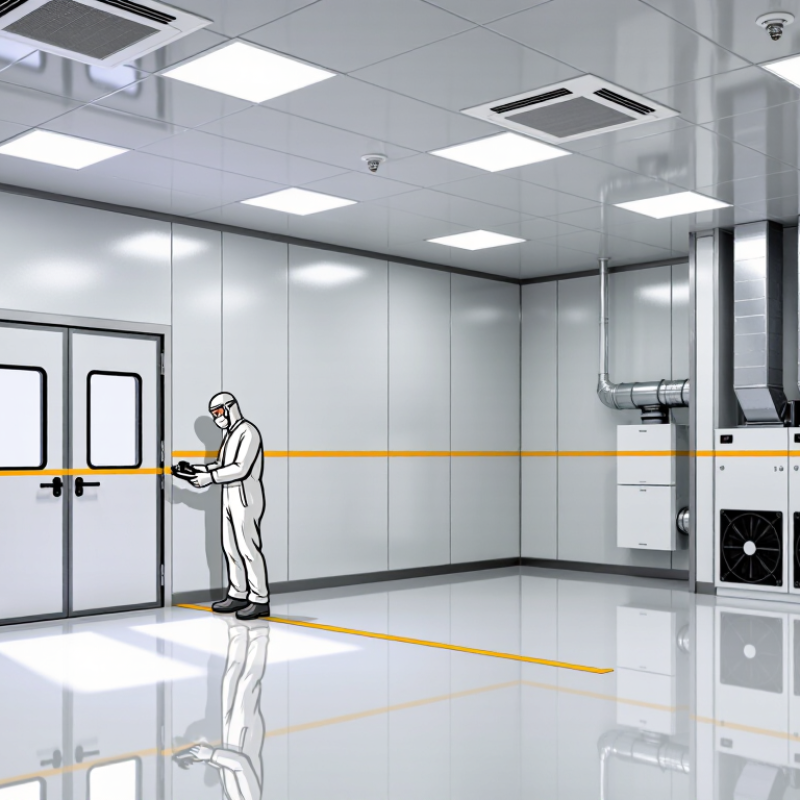
PUF Insulated Clean Room: Definition and Core Construction
A PUF insulated clean room uses polyurethane foam sandwich panels to create a controlled indoor environment. PUF means polyurethane foam, a lightweight core with strong thermal insulation. The panels usually contain a metal surface on both sides. Their sealed structure helps limit dust, temperature changes, and air leakage.
Core construction begins with the wall and ceiling panels. Tight joints, concealed fasteners, and coved corners reduce places where particles can collect. The floor should resist chemicals, moisture, and repeated cleaning. Doors need smooth surfaces, reliable seals, and self-closing hardware. A small gap can weaken the whole room.
The air system is equally important. Filtered supply air enters through ceiling terminals, while return air leaves through low wall grilles or floor points. Pressure differences help protect the room from surrounding areas. Sensors should track temperature, humidity, pressure, and particle levels. In China, local fire, construction, and hygiene requirements must guide material selection. Do not assume every PUF panel has the same fire performance. Test reports matter.
During site inspections, installers often focus on panel alignment but miss service penetrations. That mistake can cause leakage later. I would check every seal, corner, and access panel before commissioning. The “best” clean room is not simply the thickest one. It is the system that matches the process, cleaning routine, climate, and verification plan. Some designs still need revision after real operation.
Key Performance Standards for PUF Clean Rooms in China
What Is the Best PUF Insulated Clean Room in China?
Key Performance Standards for PUF Clean Rooms in China
The best PUF insulated clean room is not defined by panel appearance alone. Its performance should match the process, product risk, and local environmental conditions. In China, designers commonly refer to GB 50073 and GB/T 25915.1 when planning cleanroom layouts and cleanliness levels. These references help control airborne particles, pressure relationships, airflow, and testing methods.
Panel quality matters every day. A reliable PUF panel should provide stable thermal insulation, accurate joint sealing, and a smooth, cleanable surface. Check the core density, thermal conductivity, fire performance, and resistance to moisture. Poorly sealed corners can create hidden leakage points. Small gaps matter.
Air control requires practical verification. A qualified room should maintain the specified air changes, temperature, humidity, and positive or negative pressure. Particle counts must be tested under defined conditions, not estimated from equipment capacity. HEPA filters also need integrity testing after installation. A pressure gauge reading alone proves very little.
On-site experience shows that installation can weaken an excellent design. Misaligned panels, damaged coatings, and careless service penetrations are common problems. The specification may be correct, yet the finished room can still fail acceptance testing. This is where inspection records, commissioning data, and trained technicians become essential. There is no universal “best” PUF clean room. The right choice is the one that remains stable, measurable, and maintainable after daily operation begins.
Types of PUF Clean Rooms and Their Industrial Applications
Types of PUF Clean Rooms and Their Industrial Applications
The best PUF insulated clean room in China depends on process risk, not panel appearance. PUF panels provide strong thermal insulation, low weight, and fast installation. Modular rooms suit pharmaceutical filling, medical-device assembly, and laboratory work. Hardwall systems offer better durability, while softwall designs support lower-risk packaging and temporary production. They are not interchangeable.
ISO 14644-1 classifies cleanrooms by airborne particle concentration, from ISO Class 1 to ISO Class 9. Pharmaceutical areas often require ISO Class 5 zones near exposed products, with surrounding ISO Class 7 or 8 spaces. Electronics manufacturing demands tighter particle control, especially during wafer and sensor assembly. Food-processing rooms usually focus on hygiene, temperature stability, and washdown resistance. PUF alone cannot guarantee these conditions.
A 2023 MarketsandMarkets report valued the global cleanroom technology market at about USD 5.5 billion and forecast growth toward USD 8 billion by 2028. The demand reflects stricter production controls across healthcare, electronics, and food industries. However, market figures describe equipment demand, not actual room performance. On-site testing remains essential. Airflow visualization, recovery testing, pressure checks, and particle counting should follow documented procedures. In practice, poorly sealed joints can undermine expensive filtration. This is often overlooked. Engineers should also review fire safety, humidity control, door interlocks, and maintenance access before selecting a PUF system.
What Is the Best PUF Insulated Clean Room in China?
Typical ISO 14644-1 design targets for PUF-panel clean rooms by industrial application
How to read the chart: The values represent the maximum permitted concentration of airborne particles ≥0.5 μm per cubic metre at the selected ISO class. Lower particle limits indicate stricter cleanliness requirements.
PUF clean room types: Modular PUF-panel rooms are commonly used for pharmaceutical and medical production, walk-in rooms support larger manufacturing areas, and customized panelized rooms are suitable for electronics, food processing, and laboratory applications. The best solution depends on the required ISO class, temperature and humidity control, pressure cascade, personnel flow, and cleaning requirements.
How to Evaluate Chinese PUF Clean Room Manufacturers
What Is the Best PUF Insulated Clean Room in China?
How to Evaluate Chinese PUF Clean Room Manufacturers
The best PUF clean room is not always the cheapest or most attractive proposal. Evaluate the manufacturer behind the panels, doors, and air system. Ask for project records, factory photographs, and references from similar industries. A reliable supplier should explain panel density, thickness, thermal conductivity, and fire-performance data clearly. Vague specifications deserve caution.
Inspect the production facility if possible. Check whether steel sheets are evenly bonded to the polyurethane core. Examine panel edges, cam-lock joints, viewing windows, and sealed corners. Small gaps can collect dust and weaken pressure control. The cleanroom design should match ISO 14644 requirements and local construction regulations. Request airflow calculations, HEPA filter certificates, pressure-test results, and particle-count reports.
Documents matter.
So does installation quality.
Ask who supervises commissioning and how defects are handled. A professional manufacturer provides drawings, material traceability, cleaning guidance, and maintenance training. Compare warranty terms carefully. Some offers look complete but exclude testing, transport, or site adjustments. That can change the real cost.
One practical concern is communication. Technical English may be limited on either side, and drawings can hide misunderstandings. Use signed specifications, sample approvals, and staged inspections. Do not trust promises alone. No audit is perfect. A supplier may pass a factory visit yet struggle during installation. Keep contingency time and verify performance after handover, not only before payment.
Conclusion
A PUF Insulated Clean Room is a controlled environment built with polyurethane foam sandwich panels, sealed joints, cleanable surfaces, and carefully designed systems for air filtration, temperature, humidity, and pressure control. Its performance depends on insulation quality, airtightness, cleanliness classification, airflow uniformity, and the ability to maintain stable operating conditions. In China, clean rooms are commonly designed according to project-specific quality standards and industry requirements for pharmaceuticals, electronics, food processing, laboratories, medical production, and other sensitive applications.
Choosing a suitable Chinese manufacturer requires evaluating panel materials, structural design, engineering experience, testing procedures, customization capability, and after-sales support. Buyers should also confirm whether the supplier can provide professional installation, commissioning, documentation, and compliance assistance. Regular maintenance, including filter replacement, surface cleaning, pressure monitoring, and inspection of seals and equipment, is essential for long-term reliability. The best solution is therefore one that balances cleanliness, energy efficiency, durability, safety, installation quality, and total operating cost.